Women, body image and the beauty myth
In the last episode, I briefly touched on one of the most defining books in my life – The Beauty Myth by Naomi Wolf. So, in this week’s episode I want to expand on the importance of the book and the impact it had on me and that it should have on you, too.
I was born and raised in the 1980s, the time of neon everything, broad shoulder pads and big hair. It was also the time of Jane Fonda and Jamie Lee Curtis defining a woman’s perfect physic with their leotard outfits either in movies or exercise videos. When I entered my teenage years, it was the time of the supermodels. Cindy Crawford, Claudia Schiffer, Christy Turlington, Linda Evangelista, Karen Mulder. Women more beautiful than one could have ever imagined. They published workout videos, which I all owned and trained to – this was my start in fitness and the slippery slope to fitness and sports addiction. There was a magazine dedicated to the supermodels, aptly called “supermodels”, which I also collected religiously. Fun fact – a young Ivanka Trump also featured in there.
Then came the nineties, Kate Moss, grunge and heroine chic, just when I hit the absolute deep of puberty. Being absolutely skinny and malnourished was the hype and I followed suit. I developed serious eating disorders and lost my self completely.
This era morphed into the pop-feminism promoted by the superficially diverse Spice Girls, which were not diverse at all, but all incredibly toned and beautiful, and the pop sensations Christina Aguilera and Britney Spears, who sported pubescent tiny curves and unbelievably toned bare midriffs, accentuated by jeans so low-risen that they barely held together. This was also when Baywatch hit the screens and Pamela Anderson set the standard for an enviable female body at the beach. At the same time, Paris Hilton and Nicole Ritchie tried to make it in the wild, with the world mocking Ritchie for her weight.
I graduated right on the brink to the 2000s, when we entered Kardashian-time. Incredibly accentuated buttocks, minuscule waists and ample bosoms got into fashion. All under the disguise of body positivity – yet, a standard that was unattainable to almost anybody. Surgically enhanced physics started to dominate the gossip columns.
With the launch of social media platforms, the 2010s were shaped by increasingly computer- and filter-adhanced imagery, selfie culture and the perfect angles. Curating and tweaking images of themselves became second nature to women. And now in the 2020s we have entered the Ozempic era, where the beauty standard is more chemical induced standards, not only willpower and biohacking.
This is the timeline that shaped my understanding of beauty. We as women want to adapt and adhere. Biologically, we are wired to try to fit in and also be the most beautiful to attract a male. That is basic biology. We compare, see how we fare and try to at least fit in or be one of the leading specimen at best.
But, as you can see from my timeline – beauty itself is not a biological concept. Because biology does not change that quickly. It might change across thousands of years, but in the short timeframe of a few years or decades, this is not biology, but politics.
Although there have always been beauty standards in different parts of the worlds at different points in time, the last 100 years truly are different. As the beauty standard is not something that evolved because of circumstance and tradition, but because of political motives. To contextualise these trends, you have to keep in mind that these are Western, predominantly white, middle-to-upper-class beauty ideals – and thus they cannot and should not be understood as describing a universal female experience across all regions or classes. But, as to my own experience and the predominant narratives coming from the US, this is of importance to understand media, marketing, advertising, movies, trends and female confidence for those it affects.
So, yes: Beauty is political. Unfortunately, I did not know this for the first half of my life, which was absolutely detrimental to me, my health, my understanding of my body and my life trajectory.
So, let’s get back to the beauty timeline and expand it – to not only cover my lifetime, but the last roughly 100 years, because that truly puts everything in relation. Beauty has always been important to women and – more importantly – society. Because it is a weapon to wield whenever women become too powerful. The more power women gain, the more unattainable beauty standards get. Beauty is a tool to protect patriarchy and the establishment.
Around 1900 the first-wave suffragette movements took place, both university and professional access opens up for women. The increasing industrialisation pulled women into wage labor. Yet, the dominant beauty ideal was the Gibson Girl which was restrained in a very rigid S-bend corset and had incredibly pale skin. This excluded working women by design, as avoidance of the sun, manual work and restricted movement were necessities. Women became more powerful in the workplace and -force, their very body restricted.
When WWI erupted, women were pulled into the workforce even more and suffrage won even more ground. The First Rights Wave was accompanied by the beauty ideal of the Flapper or “Garonne” with a flat-chested, boyish and incredibly youthful silhouette. It literally required pre-pubescent or artificially suppressed adult figures – and youth, which is unattainable past a certain age. Whilst their position in society got strengthened, their ideal became immature and unattainable for women everywhere. This also started the earliest mass dieting discourse as a narrative tied to moral and willpower with calorie-counting popularised and established as a tool to achieve the boyish figure of the decade.
During the pre-war and war years of WWII, pin-up culture emerged and became the beauty ideal of the time. Whilst most women were recruited to work the jobs the men had to leave, the ideal saw glamorous curves, cheerful and happy smiles and red lips.
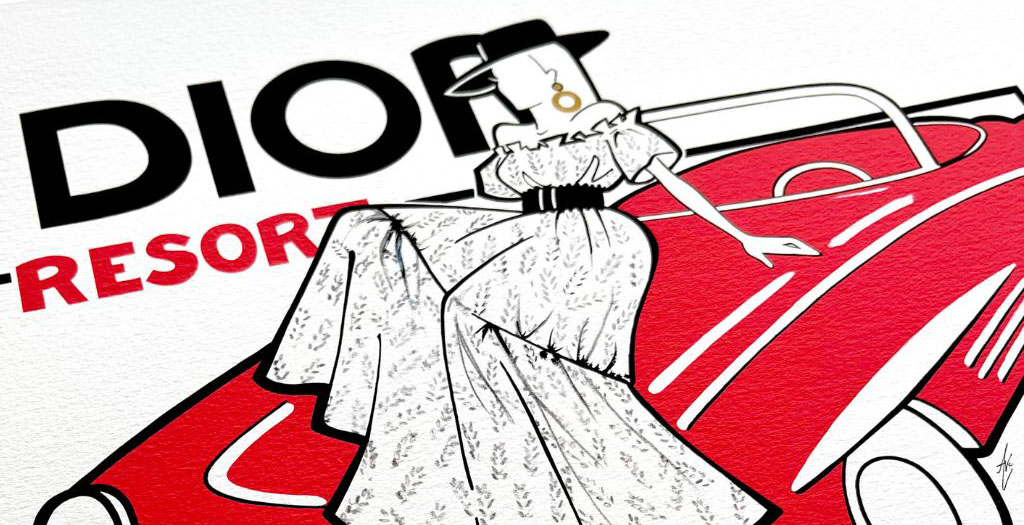
This was followed by the Long Domestic Consolidation, which was dominated by post-war “return to domesticity” ideology. Women were relegated to home and hearth, the ideal of the “perfect” housewife was propagated, and magazine and early TV frames tininess and domestic perfection as wifely duty. Diet culture started and women required girdles and foundation garments to achieve the beauty ideal of Dior’s New Look, the hourglass silhouette with cinched waists, structured bras and girdled hips. This ideal was expensive because of the many garment layers – and also the post-war abundance for women was drenched in perfectionism at home, forced happiness and thinness, and model presentation and behaviour at all functions. The perfect housewife was no longer an oppression coming from the outside, it became internalised as a script women forced themselves to adhere to.
In the sixties, the Civil Rights Act was passed, Roe v. Wade changed abortion laws, and second-wave feminism emerged. The beauty ideal? First, it was Twiggy – with her undernourished 91 pound frame she was abnormal even in the modelling industry and forced dieting into the mainstream. This was also the time that Weight Watchers were established and changed how women related to food and their bodies. The end of the decade with the Hippie movement brought to light the beauty ideal of the peace-loving earth mother, which was, again, highly unattainable – it required good skin and bone structure, perfect body composition and youth to be considered beautiful.
In the 80s, women got into positions of power in several industries and threatened the male narrative of the breadwinner. Hence, the control mechanisms tightened and turned into the ideal of disco glamour, later fitness culture with aerobicized extreme thinness and the age of supermodels. This was the time when the beauty ideal was bound to physical effort and discipline in dieting and fitness. Workout videos like that of Jane Fonda and the dieting industry peaked and grew exponentially. This was also the time when there happened a documented rise in eating disorders.
The nineties were characterised by the fall of the Soviet Union, post-communist re-legislation and EU/UN harmonisation, whilst the US grappled with the enforcement of women’s rights in the workplace and at home. The beauty ideal first shifted to Heroine chic with its poster child Kate moos, which literally was modelled on drug-addicted bodies and then turned to early tone pop-star bodies like Britney Spears, Christina Aguilera, the Baywatch girls or the Spice Girls. Ultra toned, very young, curves neither too much nor too little showing lots of skin, which then turned to the size-zero beauty ideal – or in the case of Victoria Beckham, the double zero ideal.
Then came the 2000s and 2010s, which broad the Lilly Ledbetter Act, corporate gender quotes and a new wave of marriage equality. First, there seemed to be an upsurge in body positivity, but the rhetoric was not followed by action as the Kardashian or J.Lo hourglass figure became synonymous with it. Although the marketing wanted to show inclusivity, it actually showed exclusive body types. This was also the time when Instagram and Facetune launched. Women now were focused on how they looked in selfies and duck-face was introduced. Looking fake was the goal.
Well, and then came the last era starting with the #Metoo movement, the overturn of Roe v. Wade and Trumps global gag rule. Body positive almost completely collapses and instead we are now in the Ozempic-era of extreme thinness. If I look now to the women shaping our understanding of beauty, to the red carpets of the world – we all see that the latest standard which is being labelled “toned” as in the case of Demi Moore, Ariana Grande or Cynthia Erivo is actually starving. The fact that their skeletal frame is called “toned” these days, truly exposes the agenda. Everybody wants to be toned instead of squishy – nothing bad about that. “So, let’s aim for toned” is what many women might tell themselves. The thing though is that they will get very consumed with toning down, starving, obsessing. During a time when there is more upheaval than ever before. With the Epstein files exposing the degraded male ruling class, with more angry white men dominating the world than ever before – and women start getting loud and angry. Isn’t it convenient that we are now told to become so emaciated that we can barely lift a finger?
The Three Compounding Mechanisms we can detect throughout the years are unattainability by design, gradual internalisation and sexualised visual saturation. These are the three frameworks that have shaped the beauty standards and their functionality throughout the last century – and are still going strong.
- Unattainability-by-design — every era’s ideal excludes the majority of women, whether by class (Gibson Girl), ethnicity (Nazi ideal), genetics/youth (Twiggy, flapper), health (heroin chic, supermodel thinness), or cost (Ozempic). The content changes; the function — setting the bar where most bodies cannot naturally clear it — does not.
- Internalization — control migrates from external/mechanical apparatus (corset, girdle) to self-administered, “personal responsibility”-framed labor (Weight Watchers 1963 → Fonda workouts 1982 → fitness apps 2010s → GLP-1 self-injection 2020s). Each step makes the discipline harder to see as discipline, because it’s experienced as self-improvement.
- Sexualized visual saturation — this describes a largely one-directional curve running from pin-ups (1940s) → Playboy (1953) → MTV/VHS (1980s) → internet porn (1990s–2000s) → self-produced social media content (2010s) → AI-generated non-consensual imagery (2020s). This trains the evaluative frame women apply to their own bodies, recruiting sexuality itself into the self-surveillance system.
This timeline explains quite literally that no matter which rights we as women have fought for and acquired, the patriarchal system and suppression shapeshifted and morphed into a part of women themselves, suppressing women’s freedom and sovereignty from within. The more recent, the more internalised, the more the oppression became a part of a woman’s own narrative cloaked as self-empowerment, self-realisation or self-optimisation so it barely registers as oppression anymore – because the oppresser is no longer another entity, but the women themselves.
Once you see that beauty is neither objective, nor god-given, you got the power to rewrite the script. Thus, truly, the most radical and revolutionary act of any Western woman is to love and accept herself, to not fall prey to the internalised patriarchal rules and regulations. And to finally express herself fully, focus on the things that matter to her and her life path, to the collective, to society, to the world. If all women abandoned the beauty myth and the patriarchal shackles that come with it and instead focused on banding together with other women, life for literally everybody could become better.
Listen on


Catch up on
Other Episodes of the Podcast
A new episode out every other Friday.